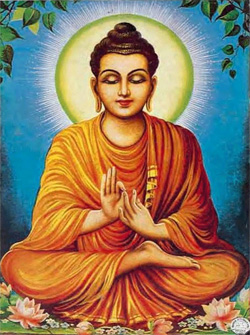
Buddhism comes from Buddha who practiced peace and compassion. His teachings influenced people’s way of life and also the way they think. His beliefs and teachings will later create the 4 noble truths and a tuneful harmony known as Enlightenment. The practice of Buddhism still goes on today along with meditation (another way to practice). This was the world's first founded religion.
Afterlife was common in this belief. After Buddha’s death, a baby was born, Sithata. There was something unusual about this baby, there was a marking on his foot. Along with these people’s religion, any marking is a sign of an important human-- whether it’s to become king and follow in the footsteps of his father (which is what is wanted) or to impact in some way. Born into royalty and constantly protected from the cruel outside world, Sithata had no idea about suffering until going out and seeing the life of others. What he saw was people aging, dying of sickness, and people begging on the streets. When he saw a man struggling to plow a field, he saw a bird come down and get an uncovered worm. After observing this, Sithata came to the conclusion that everything is connected and all actions have consequences, this thought is later known as karma. As Sithata starts to get older the world around him sends him discomfort and confusion. He decides to leave home including his wife and child to find answers to the worldly problems. He cuts off his hair and trades in his robe for rags and begins his journey in hope to find answers.
Sithatas’ first thought was he would have to experience suffering as well, also known as Asceticism. This was a common belief that included fasting and not washing. Through this, Sithata gained 5 followers on his journey. Although in doing this practice he almost starved to death before a girl saved him. After this experience, he gave up fasting and lost his followers. As he is roaming he comes across a guy tuning his instrument, he observes that it needs to be tuned in the middle for a beautiful harmony. This observation gives him the idea that he needs a middle ground to clear his mind; Enlightenment. Enlightenment’s stepping stones are morality, wisdom and meditation. Sithata goes and sits under a tree and refuses to leave until he gets a peace of mind. He goes into a deep meditation and overcomes being tempted by a demon king. After this long meditation he figures out if we can remove desire, we can remove dissatisfaction. He traveled for 6 years and in those few years he revealed something known as the 4 noble truths, which are suffering, desire, cure for desire and the prescription. After coming back home he shares his teachings and has a school opened right under the tree he meditated under- temple of the body tree. He was set out to teach for 40 years.
Some people don’t even view Buddhism as a religion. Buddhism revolves around self improvement. This differs from the religion of Hinduism in various ways. Buddhism rejects extreme asceticism, while the idea in Hinduism is extreme asceticism. Hinduism also sees the ultimate reality as being glorious and divine, while Buddhism sees the ultimate reality as nothingness. Buddhism is more within your own self and your own thoughts to be a more pure human. This is where Hinduism and Buddhism differ.
http://www.souledout.org/wesak/storybuddha.html

I'd love to know why you wrote this, why you are interested in Buddhism. I didn't know if you are taking a class about world religions or what. It is a very interesting religion with a rich mythology quite different from western perspectives.
ReplyDelete