In the rising tension of world war two, the U.S. Army put out a contract with a 45 day deadline to create a prototype vehicle capable of with standing the rugged off road conditions of the European war front. The resulting vehicle produced by Ford and Willys-Overland, was the General Purpose Vehicle, which was quickly abbreviated through slurred speech to Jeep, the term we all know today.
The vehicle was made light weight (light enough for two people to pick it up, were it to get stuck) and with improved axles and shocks to handle the rough conditions it would encounter, but also fast enough to keep up with road conditions of the era. It featured two seats, no doors, a removable soft top, a windshield that could be removed easily and a design that made maintenance exceptionally easy. All of these are features that even today's jeeps share.
For those of you familiar with the jeep wave, it's origins also begin in WWII. In the military enlisted and lower ranking officers must salute their superior officers while in uniform, as military tradition has dictated for centuries. That is unless your in a combat environment, where saluting an officer could identify them to enemy reconnaissance/snipers. That being said, a vast majority of military personnel who had access to jeeps throughout the war were higher ranking officers, so in an attempt to create camaraderie within the ranks, it became tradition to wave at anyone passing in a jeep, regardless of rank

As the war came to it's conclusion, the army had an abundance of remaining jeeps that were highly sought after by the american public, so much so that Chrysler bought Willys-Overland to begin producing jeeps for civilian use after the army surplus had been sold off. Jeeps became the first production off road vehicle in history, with their introduction to civilian use we also saw the birth of recreational rock crawling and mudding, a popular american past time. Jeeps also saw use in farming communities where they were used as tractors, saw widespread highway use, were popular in surfing communities and remained use use by the american military until after the Vietnam war. (The Jeep Wrangler was recently re-introduced into the american military as a more affordable and reliable alternative to it's stocky younger brother; the HUM-V)
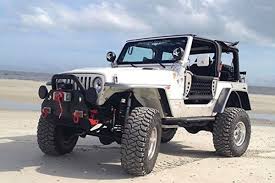 |
| 05 TJ |
 |
| 87 YJ |
 |
| 2014 JKU |
Jeep's wide spread popularity lead to it being recognized as it's own brand. In the seventies we saw the creation of the second generation of off roading vehicles, the CJ-5 and later it's longer framed alternative, the CJ-7. The new renditions brought a variety of upgrades and a more eye appealing appearance to it's predecessors, the same can be said of it's future Wrangler renditions in 87 with the introduction of the YJ, In 96 with the TJ, 07 with the JK and the up and coming JL, 2018's model which will no longer carry the Wrangler title.


My HR at my old job LOVES her jeep. It's bright green with green rims ! She also goes on a lot of jeep adventures with 100+ jeeps in the woods and all. She wants me to go with her but I'm not all for getting muddy and yucky. She got stuck once in a mud hole , actually looked pretty cool. LOL
ReplyDeleteNice history! I'm going to show off to all my Jeep-loving friends that I know where the name comes from now. :)
ReplyDelete